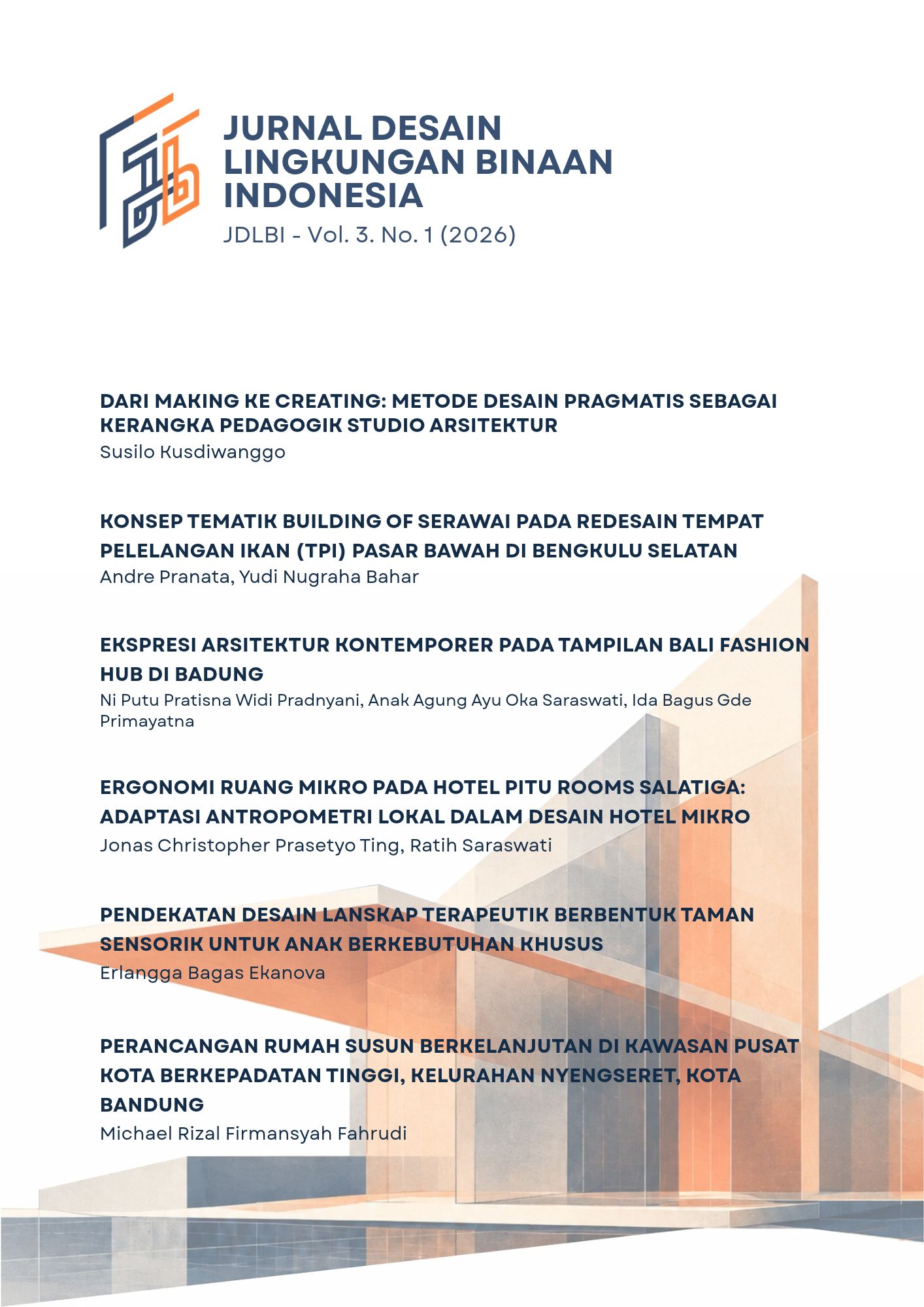
PENDEKATAN DESAIN LANSKAP TERAPEUTIK BERBENTUK TAMAN SENSORIK UNTUK ANAK BERKEBUTUHAN KHUSUS
DOI:
https://doi.org/10.32315/JDLBI.v3i1.460Keywords:
Teras Cihampelas, Ruang Publik, Pejalan kaki, Sektor Informal, Perancangan KotaAbstract
A sensory garden is an outdoor space specifically designed to stimulate the senses and support the development of children with special needs, particularly those with autism spectrum disorder. This study aims to develop a sensory garden design that integrates therapeutic approaches with landscape architecture principles, focusing on children with autism. The method used in the design process is an evidence-based design approach, combining direct observation and literature review on the sensory therapy needs of children with autism. In this design, various garden elements are crafted to provide stimulation that supports sensory development for children. The design results in a sensory garden divided into five distinct zones: visual, auditory, tactile, proprioceptive, and vestibular. Each zone is created to stimulate specific senses that are crucial for supporting the development of children with autism. The visual zone includes elements that stimulate sight, such as bright colors and attention-grabbing objects. The auditory zone incorporates sound elements that are either soothing or stimulating. The tactile zone encourages children to engage with various textures, while the proprioceptive and vestibular zones are designed to stimulate bodily awareness and balance. This design makes a significant contribution to the creation of an inclusive, effective outdoor therapy space that supports the well-being of children with autism, combining landscape architecture aspects that are both friendly and safe for them.
References
[1] Lerstrup, I., & Konijnendijk, C. C. (2016). Affordances of outdoor settings for children in preschool: revisiting Heft’s functional taxonomy. In Landscape Research (Vol. 42, Issue 1, p. 47). Taylor & Francis. doi: 10.1080/01426397.2016.1252039
[2] Hussein, H., Abidin, N. M. N. Z., & Omar, Z. (2013). Engaging Research and Practice in Creating for Outdoor Multi- sensory Environments: Facing Future Challenges. In Procedia - Social and Behavioral Sciences (Vol. 105, p. 536). Elsevier BV. doi: 10.1016/j.sbspro.2013.11.057
[3] Yuniarti, B. M., Astini, B. N., Nurhasanah, N., & Fahruddin, F. (2023). Meningkatkan Kemampuan Motorik Kasar Melalui Kegiatan Senam Meniru Gerakan Binatang di Kelompok B Paud Nusantara Desa Karangbayan Kecamatan Lingsar. In Jurnal Mutiara Pendidikan (Vol. 3, Issue 1, p. 1). doi: 10.29303/jmp.v3i1.3553
[4] Hussein, H. (2023). The Influence of Sensory Gardens on the Behavior of Children. https://www.slideshare.net/HazreenaHussein/influence-sg
[5] Rosdiana, L. Y., & Amrullah, M. K. (2021). Kindergarten Strategy in Online Learning Amid the Covid-19 Pendemic At Aisyiyah 3 Randegan. In Proceedings of the ICECRS (Vol. 10). Universitas Muhammadiyah Sidoarjo. doi: 10.21070/icecrs20211146
[6] Gunawan, W., & Purwantiasning, A. W. (2024). Study of Typology of Vertical Residential Space Patterns in Jakarta. Border: Jurnal Arsitektur, 3(1), 31–46. doi: 10.33005/border.v3i1.75
[7] Awanis, A., Amarseto, B., & Diyono, D. (2022). Kompetensi Motorik Anak Usia Dini dengan Prestasi Belajar Di Taman Kanak-Kanak (Tk) Aisyiyah 5 Semanggi. In FISIO MU Physiotherapy Evidences (Vol. 3, Issue 2, p. 73). Universitas Muhammadiyah Surabaya. doi: 10.23917/fisiomu.v3i2.17604
[8] Hussein, H. (2015). Sensory Garden: Lessons learned from the UK and Singapore. https://works.bepress.com/hazreena/78/
[9] Wake, S. J. (2007). Designed for Learning: Applying “Learning-Informed Design” for Children’s Gardens. doi: 10.1080/15330150701318778
[10] A. A. Abadi and M. R. Nugraha, “Dealing With Private and Public Space Interface Problem in TOD Area. Case Study of Batuceper Station, Tangerang,” IOP Conference Series: Earth and Environmental Science, vol. 532, no. 1, p. 012003, July 2020, doi: 10.1088/1755-1315/532/1/012003.
[11] Nikravesh, R., & Tabaeian, S. M. (2016). Sensory Garden Design Solutions in Child Friendly Environments (Case Study: The Children of the City Of Isfahan, North West-District #12, in Pre-Elementary and Elementary Schools. In Journal of Design and Built Environment (p. 7). University of Malaya. doi: 10.22452/jdbe.sp2016no1.2
[12] Lestari, D. P., Ibrohim, I., & Kustiah, S. (2021). Peningkatan Kemampuan Membaca Awal Melalui Permainan Outdoor di Kelompok B TK Islam Al Jihad Johar Baru, Jakarta Pusat. In Seulanga Jurnal Pendidikan Anak (Vol. 2, Issue 1, p. 27). doi: 10.47766/seulanga.v2i1.1402
[13] Mariana, Y., & Wijaya, Y. (2020). Healing garden implementation in rehabilitation centre at Jakarta as a concept of eco-architecture design. In IOP Conference Series Earth and Environmental Science (Vol. 426, Issue 1, p. 12081). IOP Publishing. doi: 10.1088/1755-1315/426/1/012081
[14] Senjana, S., & Putra, G. A. S. (2021). Landscape Design: Pattern and Color in Sensory Garden for Disability Justice. In Advances in Social Science, Education and Humanities Research/Advances in social science, education and humanities research. doi: 10.2991/assehr.k.210421.056
[15] Hussein, H. (2010). Using the sensory garden as a tool to enhance the educational development and social interaction of children with special needs. In Support for Learning (Vol. 25, Issue 1, p. 25). Wiley. doi: 10.1111/j.1467-9604.2009.01435.x
Downloads
Published
Issue
Section
License
Copyright (c) 2026 Erlangga Bagas Ekanova

This work is licensed under a Creative Commons Attribution-NonCommercial 4.0 International License.