| ..:: Accreditation ::.. |
 |
Vol. 15 No. 1 (2026): JLBI
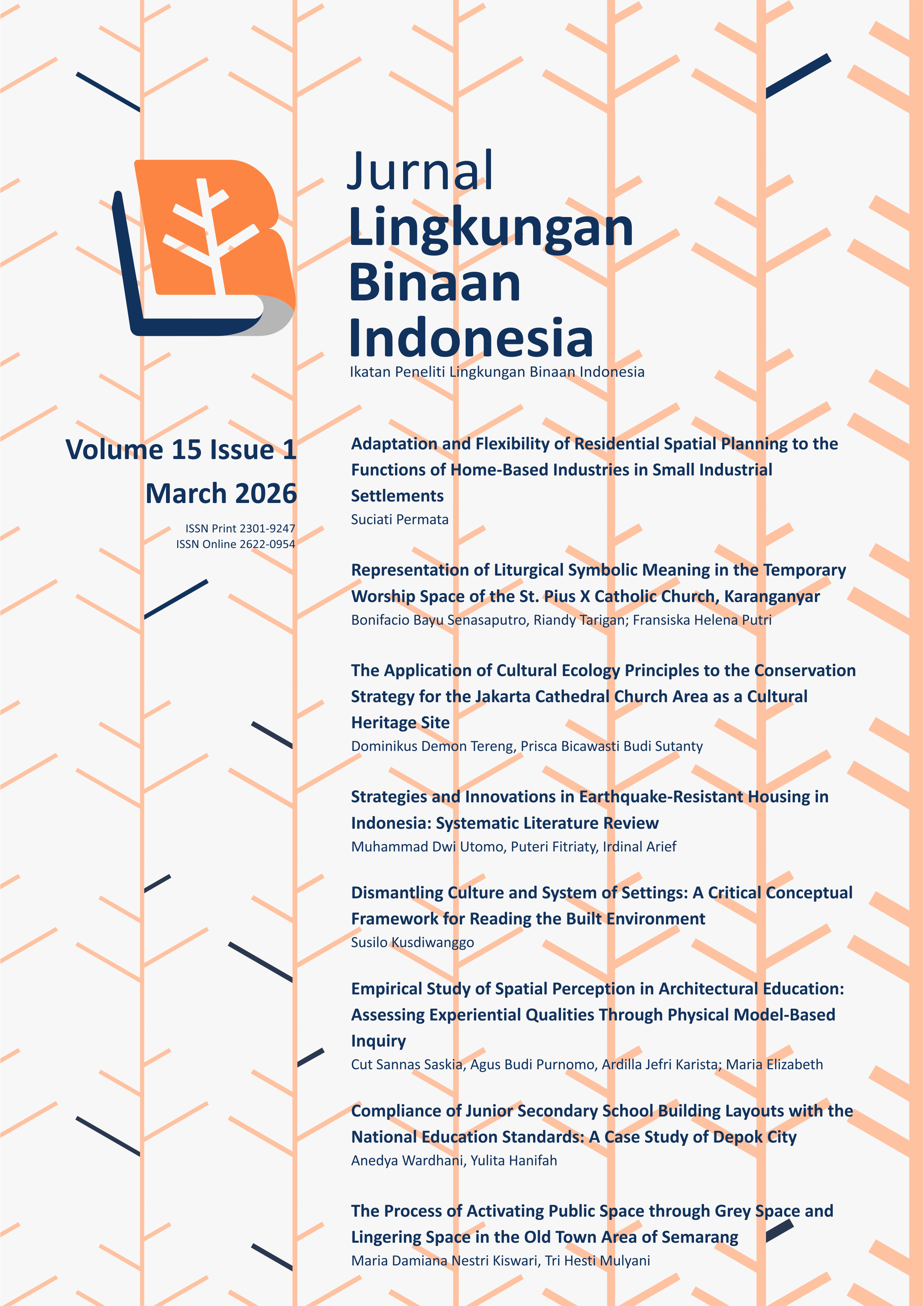
The first issue of this volume features eight articles that discuss architecture, social practices, and cultural–religious values within the built environment in Indonesia. The first article, written by researchers from Universitas Mercu Buana in Jakarta and titled “Adaptation and Flexibility of Residential Spatial Planning to the Functions of Home-Based Industries in Small Industrial Settlements,” examines how residential spaces adapt to support home-based industries through flexible spatial arrangements. The second article, by scholars from Soegijapranata Catholic University in Semarang, titled “Representation of Liturgical Symbolic Meaning in the Temporary Worship Space of the St. Pius X Catholic Church, Karanganyar,” explores how liturgical symbolism is represented in the temporary worship space of the St. Pius X Catholic Church. The third article, from researchers at Universitas Pembangunan Jaya, titled “The Application of Cultural Ecology Principles to the Conservation Strategy for the Jakarta Cathedral Church Area as a Cultural Heritage Site,” discusses the application of cultural ecology principles in conserving the area surrounding Jakarta Cathedral. The subsequent titles are “Strategies and Innovations in Earthquake-Resistant Housing in Indonesia: Systematic Literature Review,” contributed by researchers from Tadulako University, which reviews recent advancements in seismic-resilient housing strategies in Indonesia; “Dismantling Culture and System of Settings: A Critical Conceptual Framework for Reading the Built Environment,” developed by a scholar from Universitas Brawijaya offering a critical theoretical framework for interpreting cultural dimensions in spatial settings; “Empirical Study of Spatial Perception in Architectural Education: Assessing Experiential Qualities Through Physical Model-Based Inquiry,” which investigates spatial perception through model-based experiential learning; “Compliance of Junior Secondary School Building Layouts with the National Education Standards: A Case Study of Depok City,” examining the conformity of school layouts with national education standards; and “The Process of Activating Public Space through Grey Space and Lingering Space in the Old Town Area of Semarang,” which explores strategies for activating public space within historic urban environments.
Published:
2026-03-30