| ..:: Accreditation ::.. |
 |
Vol. 15 No. 2 (2026): JLBI
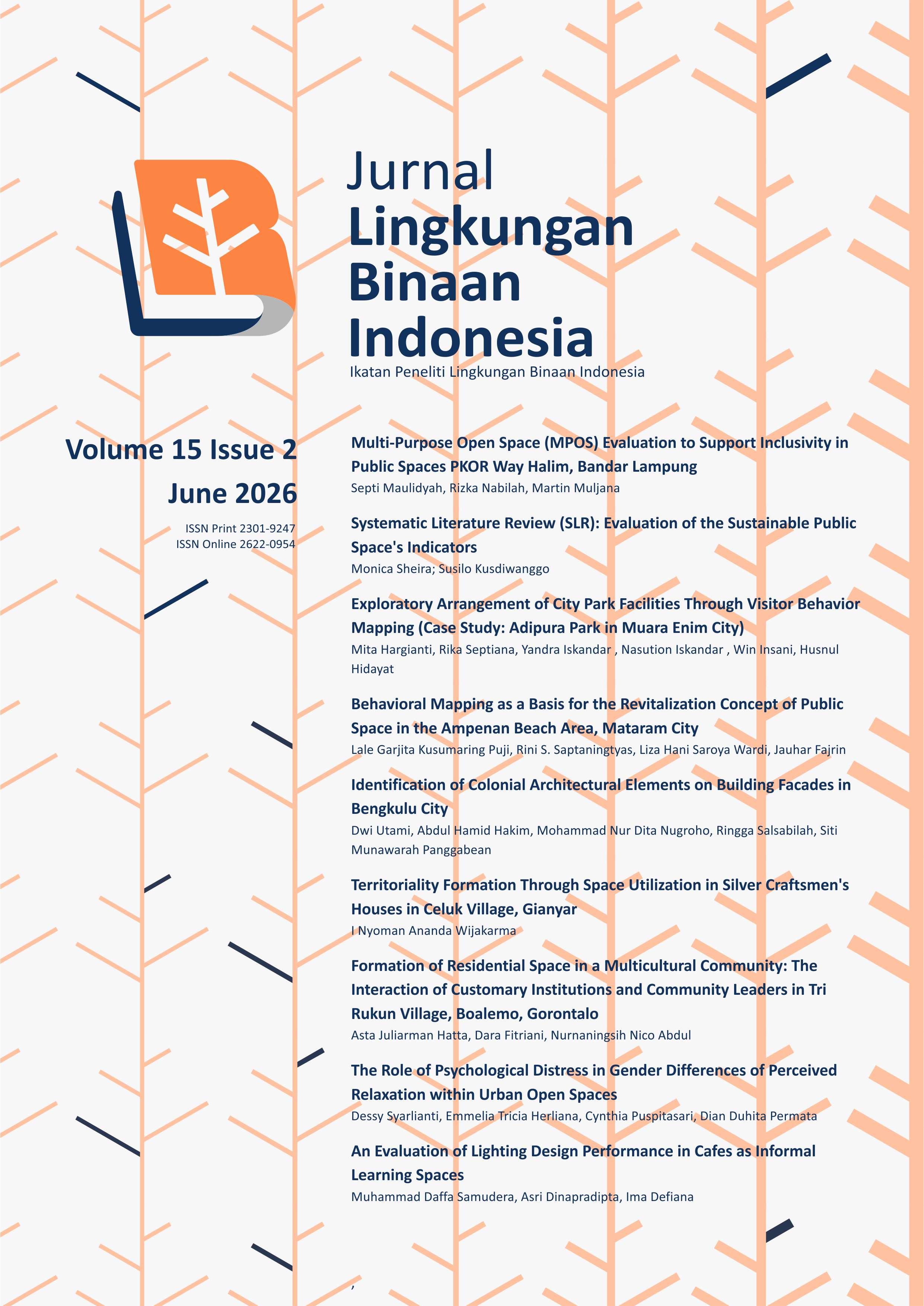
This Issue presents nine articles that explore contemporary issues in architecture, built environment studies, urban design, environmental behavior, cultural heritage, and building performance through diverse methodological and interdisciplinary perspectives. The issue begins with "Multi-Purpose Open Space (MPOS) Evaluation to Support Inclusivity in Public Spaces PKOR Way Halim, Bandar Lampung", which evaluates the inclusivity of multifunctional public spaces as an essential component of equitable urban environments, followed by "Systematic Literature Review (SLR): Evaluation of the Sustainable Public Space's Indicators", providing a comprehensive synthesis of sustainability indicators that establish a conceptual foundation for future public space planning and assessment. The application of behavioral approaches to public space design is further discussed in "Exploratory Arrangement of City Park Facilities Through Visitor Behavior Mapping (Case Study: Adipura Park in Muara Enim City)", and "Behavioral Mapping as a Basis for the Revitalization Concept of Public Space in the Ampenan Beach Area, Mataram City", both demonstrating how behavioral mapping can support evidence-based spatial planning and urban revitalization. Architectural heritage and socio-cultural dimensions of the built environment are examined through "Identification of Colonial Architectural Elements on Building Facades in Bengkulu City", "Territoriality Formation Through Space Utilization in Silver Craftsmen's Houses in Celuk Village, Gianyar", and "Formation of Residential Space in a Multicultural Community: The Interaction of Customary Institutions and Community Leaders in Tri Rukun Village, Boalemo, Gorontalo", highlighting the relationships between architectural identity, cultural values, territorial behavior, and community-based spatial organization. The issue concludes with "The Role of Psychological Distress in Gender Differences of Perceived Relaxation within Urban Open Spaces", which investigates psychological responses to urban open spaces from a gender perspective, and "An Evaluation of Lighting Design Performance in Cafes as Informal Learning Spaces", which evaluates lighting quality as a determinant of visual comfort and learning performance in informal educational environments. Collectively, these contributions demonstrate the breadth of current research in the built environment by integrating perspectives on inclusivity, sustainability, environmental behavior, heritage conservation, socio-cultural spatial dynamics, environmental psychology, and building performance, thereby providing valuable scientific insights for advancing research, professional practice, and policy development toward more resilient, inclusive, and human-centered built environments.
Published:
2026-07-04